
 Arunaagiri
A Practical Guide to Turning Prospects into Customers
Sales success is rarely the result of a single conversation or a lucky closing. Behind most successful deals is a structured sales process that helps sales professionals identify the right prospects, build relationships, create value, and move opportunities toward a successful close.
One such practical framework is SPANCO, a six-phase sales cycle that provides a structured way to manage prospects from the initial stage through conversion.
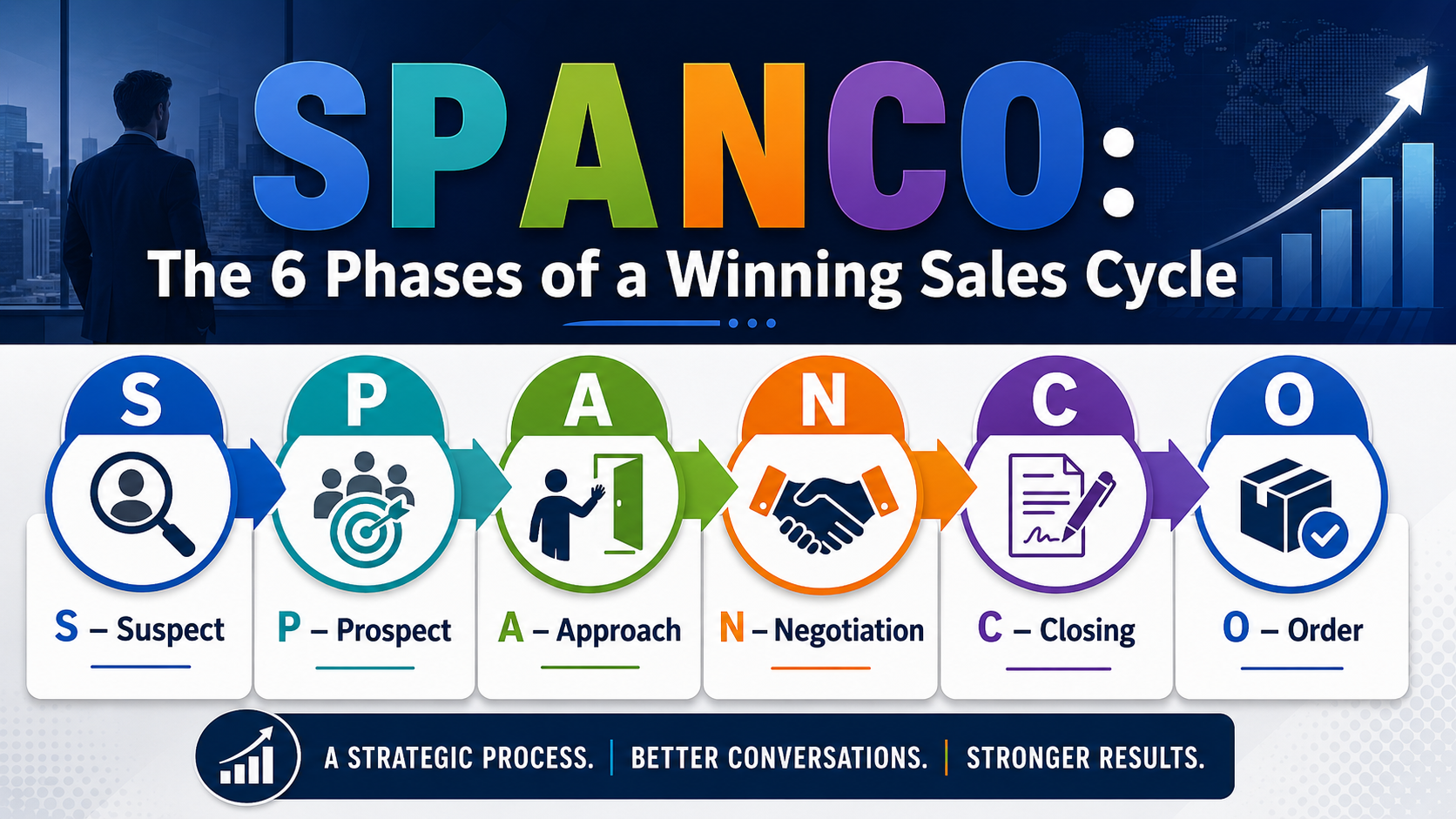
SPANCO stands for:
S – Suspect
P – Prospect
A – Approach
N – Negotiation
C – Closing
O – Order
The framework helps salespeople understand where every opportunity stands and what needs to happen next.
For sales managers, it can also provide a simple structure for coaching teams, reviewing pipelines, and improving sales performance.
What Is the SPANCO Sales Cycle?
SPANCO is a sales management framework that divides the customer journey into six distinct stages.
Instead of treating sales as one continuous activity, SPANCO helps sales professionals break the process into manageable steps.
The six stages are:
- Suspect – Identify potential customers
- Prospect – Qualify the opportunity
- Approach – Initiate meaningful engagement
- Negotiation – Build value and resolve concerns
- Closing – Secure the buying decision
- Order – Convert the sale into business
The real strength of SPANCO lies in its simplicity.
A salesperson can look at their pipeline and ask:
“Which stage is this customer currently in, and what should I do next?”
That question can bring significant clarity to sales execution.
1. S – Suspect: Identify Potential Customers
Every sales journey begins with identifying people or organizations that could potentially become customers.
At this stage, they are suspects—not yet qualified prospects.
A suspect could be someone who:
- Fits your target customer profile
- Operates in your target industry
- Has a potential need for your solution
- Has the ability to purchase
- Matches your geographic or business criteria
For example, if you sell enterprise software to manufacturing companies, a manufacturing company that fits your ideal customer profile could initially be considered a suspect.
The goal at this stage
The objective isn’t to sell.
It is to identify potential opportunities.
Sales professionals should build a healthy pool of suspects through:
- Market research
- Networking
- Referrals
- Social selling
- Events and conferences
- Digital marketing
- Prospect databases
- Existing customer introductions
Key question:
“Could this person or organization potentially benefit from what we offer?”
If the answer is yes, the suspect can move toward the next stage.
2. P – Prospect: Qualify the Opportunity
Not every suspect is a genuine sales opportunity.
This is where qualification becomes important.
A prospect is someone who has demonstrated a potential need, fit, or interest in your offering.
At this stage, sales professionals should try to understand:
- What problem does the customer have?
- How significant is the problem?
- Does the customer need a solution?
- Who makes the buying decision?
- What is the expected timeline?
- Is there a budget or commercial possibility?
- What alternatives is the customer considering?
The salesperson’s role is to move from “Who might buy?” to “Who has a genuine reason to buy?”
Avoid one common sales mistake
Many salespeople fill their pipeline with names and call it a pipeline.
But a list of contacts is not necessarily a sales pipeline.
A strong pipeline contains qualified opportunities.
Key question:
“Is there a genuine business opportunity here?”
3. A – Approach: Start the Right Conversation
Once the opportunity has been qualified, the next step is to approach the prospect.
This is where sales communication becomes critical.
The objective should not be to immediately deliver a product pitch.
Instead, the salesperson should begin by understanding the customer’s situation.
A strong approach focuses on:
- Building credibility
- Establishing rapport
- Asking relevant questions
- Understanding customer needs
- Identifying pain points
- Exploring desired outcomes
Today’s customers are often well informed. They may already know about your product, your competitors, and alternative solutions.
Therefore, salespeople need to bring insight—not just information.
From pitching to problem-solving
Instead of saying:
“Let me tell you about our product.”
A better approach could be:
“I’d like to understand the challenges you’re currently facing and explore whether there is an opportunity for us to help.”
That subtle change can completely alter the nature of the conversation.
Key question:
“How can I create value for this customer?”
4. N – Negotiation: Create Value, Not Just Discounts
Negotiation is often misunderstood as a battle over price.
But effective sales negotiation is about creating and communicating value.
At this stage, customers may raise concerns related to:
- Price
- Features
- Implementation
- Timelines
- Competitors
- Contract terms
- Risk
- Return on investment
A skilled salesperson doesn’t immediately respond with discounts.
Instead, they explore the underlying concern.
For example:
Customer: “Your price is higher than your competitor.”
Instead of immediately reducing the price, the salesperson could ask:
“Apart from price, what are the key factors you’re considering when evaluating the two solutions?”
This opens the door to understanding what really matters.
Successful negotiation involves:
- Understanding customer priorities
- Demonstrating business value
- Handling objections
- Protecting margins
- Finding mutually beneficial solutions
- Building trust
The objective is not simply to win the negotiation.
The objective is to create a deal where both parties see sufficient value to move forward.
Key question:
“How can we create an agreement that works for both the customer and our business?”
5. C – Closing: Ask for the Business
A surprising number of sales opportunities don’t fail because the customer wasn’t interested.
They fail because the salesperson never clearly asked for the business.
Closing is the stage where the salesperson helps the customer move from consideration to commitment.
Depending on the sales environment, this could mean:
- Confirming the purchase decision
- Getting approval
- Finalizing commercial terms
- Obtaining signatures
- Confirming implementation
- Agreeing on the next action
Closing should not feel like pressure.
If the previous stages have been handled properly, closing becomes a natural progression of the sales conversation.
Some useful closing questions include:
“Are you comfortable moving ahead with this solution?”
“Shall we proceed with the next step?”
“Would you like us to initiate the implementation process?”
The salesperson must have the confidence to ask.
Key question:
“Is the customer ready to make a commitment?”
6. O – Order: Convert the Decision into Business
The final stage is Order.
The customer has agreed to move forward, but the salesperson’s responsibility doesn’t necessarily end with the verbal commitment.
The order needs to be properly converted into actual business.
This may include:
- Purchase order
- Contract completion
- Payment confirmation
- Documentation
- Delivery coordination
- Implementation
- Internal handover
This stage is particularly important because poor execution after closing can damage customer trust.
A successful sale isn’t simply about getting the order.
It is about ensuring that the promise made during the sales process is delivered after the sale.
Key question:
“Have we successfully converted the customer’s decision into a fulfilled business commitment?”
Why Is the SPANCO Model Important for Sales Teams?
One of the biggest challenges in sales management is lack of visibility.
A manager may ask:
“How many opportunities are in the pipeline?”
A salesperson might respond:
“We have 50 prospects.”
But what does that actually mean?
SPANCO provides greater clarity.
A sales manager can categorize opportunities as:
| Stage | Meaning |
| Suspect | Potential customer identified |
| Prospect | Opportunity qualified |
| Approach | Customer engagement initiated |
| Negotiation | Commercial/value discussions underway |
| Closing | Customer moving toward commitment |
| Order | Business confirmed |
This makes sales conversations more meaningful.
Instead of simply asking:
“How much will you sell this month?”
a manager can ask:
“How many opportunities are currently in negotiation, and what is preventing them from moving to closing?”
That leads to better coaching.
How Sales Managers Can Use SPANCO for Coaching
SPANCO can become more than a sales process.
It can become a sales coaching framework.
For example:
If a salesperson has too many Suspects
The problem may be qualification or targeting.
If there are many Prospects but few Approaches
The issue could be confidence, communication, or prospecting discipline.
If opportunities remain stuck in Approach
The salesperson may need help with discovery and customer engagement.
If negotiations are taking too long
The team may need training in objection handling, value selling, or negotiation.
If deals reach Closing but don’t convert
The salesperson may need better closing techniques or stakeholder management.
This helps managers coach based on actual sales behavior rather than assumptions.
SPANCO and Sales Pipeline Management
A healthy sales pipeline isn’t simply about having a large number of opportunities.
It is about having opportunities moving consistently through the sales cycle.
Sales managers should monitor:
- Number of opportunities at each stage
- Conversion rate between stages
- Average time spent in each stage
- Reasons for stalled opportunities
- Win/loss ratio
- Sales cycle length
- Revenue potential
This allows organizations to identify bottlenecks.
For instance, if a large number of opportunities remain stuck at the negotiation stage, the organization may have a negotiation problem rather than a lead-generation problem.
That’s a very different problem—and requires a different solution.
Common Mistakes Salespeople Make When Using a Sales Cycle
Even with a structured framework, salespeople can make mistakes.
1. Treating Every Contact as a Prospect
Not everyone who responds to a call or email is a qualified opportunity.
2. Moving Opportunities Forward Too Quickly
A salesperson may push a prospect toward negotiation without properly understanding their needs.
3. Focusing Too Much on Price
Discounting too early can reduce profitability and weaken perceived value.
4. Avoiding the Closing Conversation
Some salespeople continue presenting information instead of asking for a decision.
5. Ignoring Post-Sale Experience
Winning the order is important, but delivering the promised value is what builds long-term relationships.
How to Make SPANCO More Effective
Organizations can improve the effectiveness of the SPANCO framework by combining it with:
Clear Qualification Criteria
Define exactly what qualifies an opportunity to move from one stage to another.
CRM Discipline
Ensure salespeople update pipeline stages accurately and consistently.
Regular Pipeline Reviews
Managers should focus on movement, bottlenecks, and next actions—not merely numbers.
Continuous Sales Coaching
Use actual opportunities from the pipeline to coach salespeople.
Metrics at Every Stage
Track conversion rates and time spent at each stage.
Customer-Centric Selling
Ensure the process is designed around the customer’s buying journey, not just the company’s sales targets.
SPANCO Is More Than a Sales Acronym
The real power of SPANCO lies in the discipline it brings to sales execution.
It helps sales professionals understand that every deal has a journey.
You identify the right customer.
You qualify the opportunity.
You approach with relevance.
You negotiate based on value.
You confidently ask for the business.
And finally, you convert the commitment into an order and a successful customer experience.
When sales teams consistently manage these six stages, they gain greater visibility, better pipeline control, and a more predictable approach to revenue generation.
Successful selling isn’t about talking more.
It is about having the right conversation at the right stage with the right customer.
SPANCO provides a simple framework for doing exactly that.
For sales professionals, it creates clarity.
For sales managers, it creates visibility.
For organizations, it creates a repeatable sales process that can be measured, coached, and improved.
Sales performance improves when salespeople stop treating every opportunity the same and start managing each opportunity according to where it is in the buying journey.
That is the real value of the SPANCO sales cycle.







Add comment